
Resident Evil
My review for the mother of the Survival Horror genre
A game originally released in 1996, the first to ever use the term “survival horror” to refer to itself. This is was the entryway for a whole generation into a genre that has seen a resurgence in recent years, thanks to the franchise’s return to its roots, from RE7 to the remakes, and its latest title, Resident Evil Requiem.
When I played RE2, I thought going to the original may be kind of a drag, that I would have more difficulty getting used to it, that it would be clumsier, unfair, and outdated.
I heard everywhere that Resident Evil for the PS1 was not worth playing when the Remake for it—originally released on the Game Cube—exists. Most people said it was too archaic and not fun at all in comparison.
That was not my experience at all.
You should be aware though, that I’m someone who is completely on board with prerrendered backgrounds, fixed camera angles and tank controls. I completed RE2 and have never even touched RE4 or anything after it. So, giving this game a try for the first time, I have to say I had a great time, so, here’s my review for it!
Everyone is aware of the Zombie-apocalypse trope by now, popularized in the late 60s by Romero’s Night of the Living Dead—a fantastic film that holds up well even today—which became franchise that explored different facets of the idea.
Those films inspired and changed the landscape in the industry. The film took itself seriously, and it showed. Watching the original, during that news report explaining the situation with that monotonous news presenter voice so common at the time, the challenge the characters faced was made clear. When the story continued and that ending sequence happened, I could only watch as history was made in cinema.
However, not every horror movie gets to be Night of the Living Dead, most of them couldn’t afford to have good camera work that hid the bad effects at the time, most of them couldn’t have actors that actually knew how to act, most of them were unable to write a story that made sense, or memorable characters. Even the good ones still had plenty of caveats, and even some of the later entries in Romero’s franchise, as great as they were, would inevitably contain a certain element that is always present in those old horror films: they are campy.
My native language is Spanish, words like “camp” weren’t really in my vocabulary for most of my youth. But once you learn what they mean, you just know it when you see it.
This game pretty much let’s you live through an bad 80s horror movie, and it delivers. Although it’s relevant due to its unique setting and memorable characters, it’s the bad writing and the absolutely horrendous yet charming voice what has made it a cutural icon, and source of memes and references that have stayed with us to this day.

You control either Jill Valentine (my beloved) or Chris Redfield, members of S.T.A.R.S, a special team of Raccoon City’s Police Department, investigating some mysterious murders and dissapearances in a nearby forest. However, the team is suddenly attacked by wild beasts, who chase after you, until you come across a strange mansion and manage to get in, with only a few other members of your team, trapped by the dangers outside.
Not an infested city, a scary cabin or an abandoned mall. You are going through a mansion, a huge place that felt lived on until recently fairly. Here’s where the horror begins as these characters start to speak, and the writing and voice acting make their appearance. Truly horrifying stuff, they didn’t even try! But even so, I love it.
After you are sent to investigate and look around, you will encounter your first enemy. You see a bald headed creature eating something, you hear the sounds of bones and flesh tearing, a dead body with its head chopped off—one of your teammates. The creature turns, its pale face looks at you, its eye popping out, no consciousness to be seen, and now, it is walking towards you…
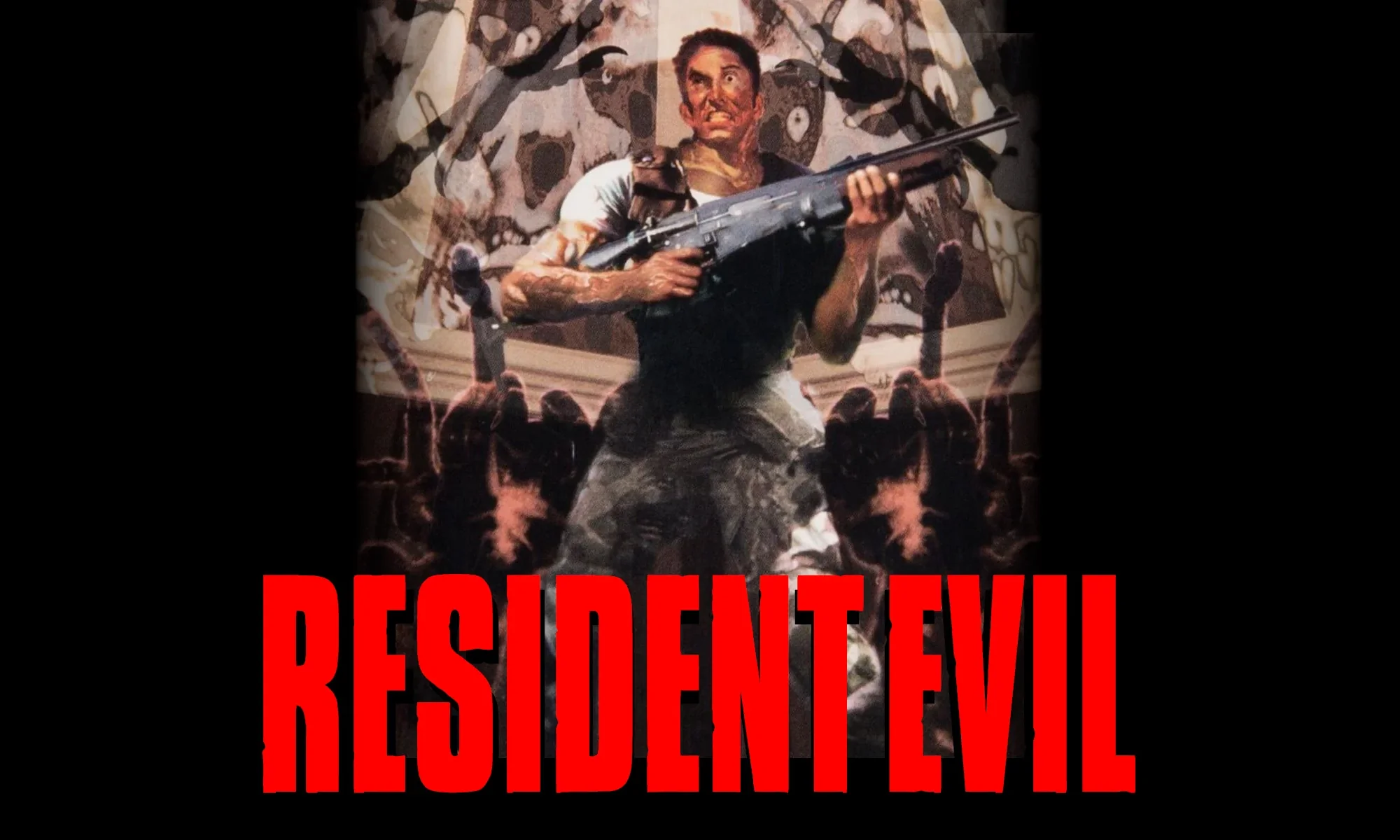
The introduction of the first zombie remains in the memory of anyone who got this back in the day. I looked it up, and the instruction manual doesn’t even feature the word. The original game cover features some distressed guy with a military uniform in a room with strange shapes and some giant spiders.
As an aside, it’s a cover that gets weirder the more time you see it. half of the guy’s face and body language is ready for action, while the other half shows him absolutely terrified, it seems like the cover was meant to emphasize that. Even the gun held by each hand is different, but merged in a weird way. It ended up looking rather strange, but it was definitely eye-catching. Still, there was a real chance that someone picked up this game and didn’t even know it would be about zombies (fine, the back of the game makes it very clear, but anyway).
The very early CGI of the FMV may not be that scary today, but the audio design is still more than great. And the scene itself is well done.
However, Resident Evil is Resident Evil.
Right after the horror, the stressful music, the creepy atmosphere; it is time for the campiness and bad voice acting of the game to take over. Jill runs away back to Barry—one of your teammates—who quickly deals with the zombie—“Let me handle this”, he says—voice lines performed by people who clearly were not in the same room, probably not even directed, simply read aloud. And after such a traumatic experience, what does Jill have to say? “Anyway, let’s report this to Wesker!”
You may think that such a contrast ruins the atmosphere and tarnishes the story and characters. The bad voices, the terrible script, not even giving some time for the characters to grieve the loss of a teammate or just be silent for a bit.
So what do we do instead? We go back to the dead body of our friend and pick up a couple of clips for our hand gun out of him, we backtrack a bit to see another cutscene, and then we learn how to save the game, yay!
Resident Evil as a series is not afraid to say something that a lot of modern videogames fear more than a zombie: It’s a videogame.
This game is absolutely focused on its gameplay, so much so the formula barely changed from here in the first three games. Go from room to room in some labyrinthical space, unlock doors with keys hidden all over the place, solve puzzles that nobody would ever do in real life, avoid enemies by taunting them to attack where you are not, get a couple of jump scares and even some FMV cutscenes out of nowhere.

The mechanics of this game would only be minimally revamped on RE2—they control virtually the same. You have eight inventory slots, you get different weapons as the game goes one. I only played as Jill, and she can use a lockpick, letting you unlock many rooms that aren’t available to Chris without a key.
The way you save the game is a game mechanic in itself, this game introduced the Ink Ribbon, an item that let’s you use a typewriter to save your progress. This is a limited resource, but the game provides plenty of them.
The mansion is an fun place, with a lot of rooms, and I am truly amazed by how easy it became for me to know where I was in most cases. Every room in the game is pretty different, and besides the mansion, we also explore a courtyard, an underground area, a guardhouse and of course, the beginning of a long-standing tradition in the franchise: an underground laboratory.
The enemy variety is pretty good, but later entries would improve on the designs, as most of the zombies look exactly the same. The other enemies are fun though, there are zombie dogs, mutated plants, and zombie crows and a couple more as the story continues. such as the Hunters, which ramp up in difficulty once introduced, with one of the most scary but also campy FMVs in the game, showing they are smarter, faster, and can open doors—even if they never do it during the game itself.
The back and forth in this game is quite big as some puzzles take place across multiple rooms and even multiple areas. You will need to keep the inventory in check, or you’ll end up stuck. You can’t drop items, but you can combine herbs, and even waste ammo if you need an extra slot. Every choice matters here, as your survival and progress will be at play.
I really enjoyed the puzzle design, even more than the in the sequel, I think, which focused on more action. There are some rooms in RE2 which will have four or five zombies in one passageway, but in RE1 there will only be one or two, and it’s likely that only one of them notices you, while the others are far away. I was able to save ammo better—but this is also thanks to my experience on the other game—and plan routes easier, which helped given how many puzzles or keys are used throughout the many areas.
The bosses aren’t very good here, but they are not unfair at all either.
This is day of #100DaysToOffload
Comments
If you have something to say, leave a comment, or contact me ✉️ instead
Reply via Fediverse
You can reply on any Fediverse (Mastodon, Pleroma, etc.) client by pasting this URL into the search field of your client:
https://fosstodon.org/@joel/idcomments
Are you looking for more? Here's some more great content for those who dare scroll down this section of the page. Suit yourself!


